On Sunday morning (July 18, 2010) at 11am I’ll be playing solo at a little coffee place called Nomad Cafe. It’s on Shattuck in Oakland, a block or so from the Berkeley line.
This is the second time I’ve played there. It’s a really relaxed and pleasant thing to do — have a latte, read the Sunday paper, play a bit in this nice sunny space.
Africa Polka is a song I got from Turner’s Banjo Journal #10, a British magazine of sheet music from the 1880s or 1890s. I think it was a yankophile thing populated mainly with American music. There was a banjo fad going on in England, an early example of American folk culture crossing over to the top of the pops. It was similar to the way that Howling Wolf’s shows in Britain in the 1960s influenced the Rolling Stones and Eric Clapton.
I was playing with live dancing in mind. The part with just chords and no melody might be fun to jam over — the chords are C-G-G-C and G-D-D-G.
The guitar has a couple rattles. There’s a blooper note near the end that I am hoping doesn’t really affect anything. YouTube reencodes the original video to sound and look really bad.
Punk was against solos. The Ramones, Sex Pistols, Clash made the absence of a guitar hero in their lineups a strength. It was ok to have pre-arranged instrumental elements — the guitar line in the Ramones’ version of “California Sun”, the melodies in Ventures covers — but the idea of soloing was squarely against doctrine.
The doctrine was DIY. Anybody can do this. It’s the people’s music. Three easy chords. Roll Over Beethoven. It was a cause, a manifesto, a revolutionary creed.
But in a sense instrumental virtuosity is more plebeian, more open, more democratic. Guitar heroism is the people’s choice. Guitar heroics appeal to the people. The public demands them.
The reason the public demands them is that heroics are entertaining. It’s not music, it’s acrobatics, true. But that isn’t a drawback for most people. Acrobatics are easier to understand than music! Acrobatics create a climax in the arc of concert that music is hard pressed to match.
Compare Yngwie Malmsteen’s ultra fast metal riffing context to Bill Evan’s complex piano chord voicings on Kind of Blue. Compare stupid but hot drum solos at an arena rock concert to sophisticated but emotionally frigid post-WWII classical music like Milton Babbit. (And leave aside the rare cases where instrumental acrobatics hit the target on a musical level). Instrumental heroics are crowd pleasers.
Purist punk has never been the music of the masses. The people speak with their numbers, and their numbers are squarely on the side of music that not anybody can do. The people want to be amazed by virtuosos.
This is an old story. Cheap thrills or elitist ecstasy — pick one. The thing that amazes me is how punk turned the narrative inside out, so that the thing the people loved (virtuousity) became elitist and the thing the elites loved (purism) became populist.
This song isn’t well known, I guess, but in a way it’s not obscure at all, since a little part of it was adopted by a TV commercial and became known as The Oscar Meyer Weiner Song: “I wish I was an Oscar Meyer weiner, that is what I’d really like to be / cuz if I were an Oscar Meyer weiner / everyone would be in love with me.”
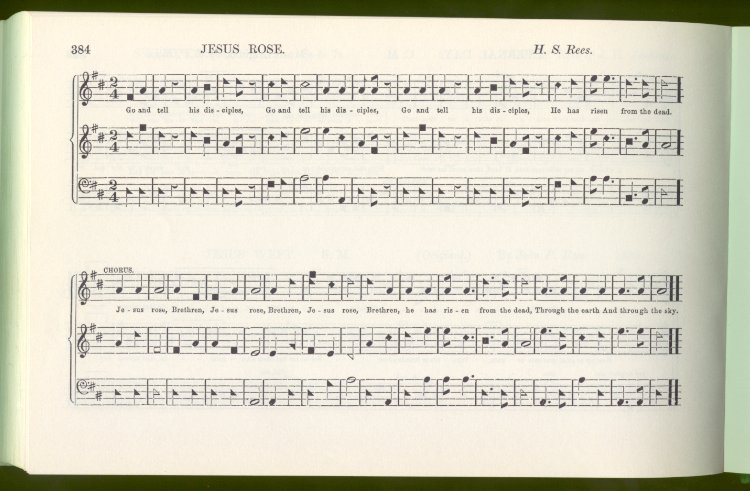
The source site that I learned this from is a good hearted project. It was a page titled “19th Century Tunes” that describes itself this way: Click below to get gif files of some 19th Century Tunes from old books I own. That’s it. Nothing complicated — somebody took a bit of trouble to scan some old books, and after a while other musicians had the pleasure of turning the scans into sound. I believe the person who created that page and the scans is mandolinist named Jim Garber.
The management of this publication admits that errors were made. In the earlier entry on “Relax Your Mind” by Leadbelly the author said that it was about road rage. On subsequent examination it turned out to be about paying attention to your driving.
The management also wishes to apologize for only doing the music notation in the key of C#, which is painful to read because it has seven sharps. It also wishes to apologize for using the convention from guitar notation of using ledger lines below the staff for the lowest notes, because a guitar tuned down a minor third is ridculously low and nobody can read that shit. On subsequent examination the management decided to show the tune in C and move it to an octave which sits where it belongs in the stave. Which looks like this:
This slim, oblong book contains as much community effort, as much eccentricity, and as much rich material as any of the shape‑note hymn compilations it is designed to resemble. It has a layered and recursive form, in which various streams separate and converge: a biography, a personal memoir of the folk revival, a critical survey of scholarly literature on African American Sacred Harp singing, a generous selection of evocative photographs spanning the twentieth century, and a CD that ranks among the most valuable and carefully compiled collections of historical Sacred Harp recordings ever assembled. John Bealle’s introduction plays the role of the traditional “rudiments of music” section of a shape‑note hymnal, providing a concise and sensitive history of Sacred Harp singing, its diverse adherents, and its intersections with the folk revival. Joe Dan Boyd’s prologue prepares the reader to engage the main body of the book (which dates from 1969) as a document of “the eager, innocent spirit by which so many people engaged traditional culture at that time” (p. 24). Boyd’s self‑awareness pervades the book and makes it a more complex work than most other celebratory folklore biographies.
In many respects, judge Jackson (1883‑1958) was much like other leading figures in the southern communities that sang from The Sacred Harp in the early twentieth century. He was born poor and rural, did agricultural work all his life, gained a patchwork music education from a variety of singing‑school teachers and friends, taught his own large family to sing, became a prosperous and charismatic cultural leader in his own community, and eventually compiled a shape-note tunebook that included some of his own compositions.
Update 3 days later: see Corrections for a version of the notation which ordinary mortals can read.
I put some time this morning into figuring out the guitar riffs on a
tune called “Relax Your Mind” by Leadbelly, aka Huddie Ledbetter. It
took some sweat so I figured I’d share the result for other people
to use.
Notice that the part is in the very unusual key of C#. I think
Leadbelly tuned the guitar down a minor third, so that the E string
was C#, the A string was
F#, etc. Since I don’t tune like that I modified the lowest note in
the piece from low C# to C# an octave above that, on the 4th fret of
the A string. If you feel like tuning down, the note I changed is the first
one in bar 4.
The chords for the song are the same throughout: C#, C#7, F#, C#, C#, G#7,
C#. It’s an eight-bar pattern rather a 12-bar pattern like bar bands
usually do.
If you want to tweak the sheet music and have Sibelius (the
software I use for notation), here is the source Sibelius file: Sibelius
source file.
If you use a digital instrument instead of the analog kind, here’s a MIDI
version of my transcription: MIDI
version of my transcription.
A cool thing about this song is that it’s about road rage, even
though it was written way back in the 1930s. He’s saying that when
you’re getting pissed off about driving you need to take a deep
breath. Given that he was a full bore murderer, I think he knew about
road rage.
His musical ideas here are strongly influenced by ragtime and early
jazz. He leans on chromatic runs that are close cousins of boogie
woogie. The phrasing is so intricate that in one cadence he touches
almost every pitch in an octave without doing more than three
adjacent semitones.
I probably muffed a couple notes in my transcription, so please
share any corrections you come up with.
I found the original recording on MOG and on YouTube.
Jane i left you and them boys for no other reason than this to come here to procure a littl property by the swet of my brow so that we could have a place of our own that i mite not be a dog for other people any longer.
The owner of the Bazaar Cafe has put a large sign on the wall, easily seen from the audience as the musicians perform. It reads, “ASCAP and BMI want my dough. If you play covers, out you go.”