Author Archives: lucasgonze

old time night at Redcat Lounge thurs 6/18

Lucas Gonze in Americana night at REDCAT Lounge

Next Thursday 6/18 I’ll play at the downstairs bar at Disney Hall, called REDCAT Lounge. It’s an early bill from 6-9 to accommodate working people, the kind who don’t go out late during the week but would dig having a drink after work.

This is a night that I did the booking for. The other acts are fine local musicians who I play with pretty often —

* The inimitable Dick & Jane.

* The invincible Triple Chicken Foot

* A couple players from Sausage Grinder, which does jug band songs like Mississippi Sheiks in an authentic style with all the details.

Where? 631 West Second St., Los Angeles! But here’s a map:


View Larger Map

Triple Chicken Foot:
Triple Chicken Foot

Rocking Yukon Gold mp3, sheet music, midi, Garageband project

When I was thinking about to do with my “Rocking Yukon Gold” soundtrack, I wanted to do something like a cowboy death song. I didn’t want to do yet another version of “Streets of Lauredo” (aka Saint James Infirmary), so what I used instead is a sad gospel number called “Talk About Sufferin'”.

I decided to do a multrack recording instead of the acapella feel I usually do, and to get all the parts to line up I wrote down melody. So, for the benefit of people who want to play the song for themself, here’s that.

Talk About Suffering (Sibelius file for anybody who wants to modify it)

Talk About SufferingClick for full-size

I set the tempo of the song so that the overall length would be about the same as the video clip, then exported a MIDI file to send to Garageband. For people who might want to use the song in an electronic context like a remix, here’s that:

Talk About Suffering (MIDI)

That MIDI has the exact arrangement I used here, including a two-bar count-off, so you’ll probably want to clip parts out. You could also use it to make your own music to fit the clip.

Over in Garageband I put the MIDI file in its own track, then created some real instrument tracks for recording.

I did the recording with an SM 81 mic through a TubeMP preamp via USB into a Macbook. I made the recordings by playing along with the MIDI file, using it to keep everything in sync. The guitar was a National Estralita.

I did three tracks in this order, rhythm guitar, whistling, bottleneck guitar. In the mix I panned rhythm center, whistling and bottleneck on either side. I’m happy to release stems for parts, just ask.

Even though the source song is called “Talk About Suffering”, my version here is called “Rocking Yukon Gold.”

Here’s the mix as an audio file:

Rocking Yukon Gold (MP3)

Rocking Yukon Gold (AIFF)

No Flac or Ogg version today. If any person out there can show me a single additional listen that I’ll get as a result of making them, I’ll make them. I dare you. I want to do it, but I don’t want to be fooling myself.

To make it easy for people who have Garageband to get in there and do whatever they want, I have created a zip file of the multitrack Garageband project. This has the MIDI and all three tracks:

Talk About Suffering (Zip of Garageband project)

My own copyright in this is hereby waived courtesy of the Creative Commons 0:

The person who associated a work with this document has dedicated this work to the Commons by waiving all of his or her rights to the work under copyright law and all related or neighboring legal rights he or she had in the work, to the extent allowable by law.

The CC 0 deal comes out this whole blog conversation about CC 0 that Victor Stone started.

Here’s the foobar for the copyright stuff:


CC0


To the extent possible under law, Lucas Gonze
has waived all copyright and related or neighboring rights to
Rocking Yukon Gold.
This work is published from
United States.

Rocking Yukon Gold

The varmint Soapy Smith lived and died in the hellishly cold northland up by the Russian border and the Soapy blog blogs about a part of the Library of Congress subsite on the joint history of Alaska and Russia which contains a goldmine of information, artifacts, documents and photographs on the Klondike gold rush era history.

I went prospecting in there and stumbled across a a dusty reading room with cowboy-era footage from Alaska. I especially liked an Edison clip from 1901 entitled Rocking Gold in the Klondike.

CREATED/PUBLISHED

Thomas A. Edison, Inc., 1901

NOTES

From a single-camera position, the film shows sluice boxes as they are operated by gold miners in the Klondike gold fields.

Cameraman: Robert K. Bonine; Location: Yukon Terr., Canada

Copyright H4088, May 6, 1901; 31 ft., FLA3065 (print) FRA0408 (neg.)

I though about posting the clip on Soupgreens.com, and then I thought of Marco Raaphorst’s Klankbeelds, where he does a soundtrack for a photograph, and I decided to do a little soundtrack.

quills => black winds

Instruments that originated among the black population had to be cheap. They used the body: patting juba, whistling, singing. Or they could be made out of materials in the woods, like making banjos from gourds and pipes out of split bark; both of these instruments came from Africa.

This kind of pipe was called “quills.”

I was thinking about black American wind playing influenced by quills, so I made a playlist:

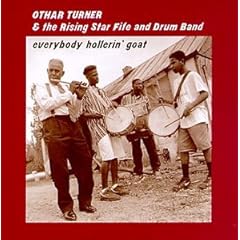
Otha Turner’s fife and drum style is mid- 19th century.
Henry Thomas’ blues quills are early 20th century.
Yusef Lateef’s jazz flute is late 20th century.

Otha Turner -> Everybody Hollerin’ Goat -> Shimmy She Wobble

Henry Thomas -> Texas Worried Blues -> Charmin’ Betsy

Yusef Lateef -> Eastern Sounds -> The Plum Blossom

party music

I jammed all evening in the garden at Dick & Jane’s party on Friday, and I had a great time.

We had good players, including mandolin, fiddle, and resonator guitar, and IMO we made a crunchy little beat happen. You could tell by the gushy reactions when we got up to leave.

So here’s my plea: hire us! We don’t need amplification, you don’t have to give us money, we’re not going to steal silverware, and we’ll make it a happening little party. It’s easy — just send me driving directions and I’ll do the rest.

remix w/o finance

@atduskgreg has remixed one of the jazz recordings I posted on Soupgreens.com about a year or so ago. From his tumblr log:

Today, I re-discovered some old loops I’d made from one of Lucas Gonze’s Alvin and Lucille songs and end up working them up into the bones of a song. Next up will be bass and some percussion overdubs, but what you’re hearing here comes entirely from the guitar part for Romance Without Finance.

His mix is a sythetic alien mime with a sexy walk. Pretty much.

Incidentally, the guitar tone on that recording comes from the unique instrument — a 1930s remake of an 1890s parlor axe. That small-bodied style of guitar has a distinctive boingy sound in the bass. No low end thump at all, but lots more wiggly high end than on a modern instrument. Here’s photos:


I need to find a way to cover or remix contemporary internet-based stuff like this without abandoning my premise. It’s good to make my stuff available for other people to remix, but it’s narcissistic to do it without also remixing other people’s music.

I brought this up over on Twitter:

I wish that my own genre of guitar instrumentals had some way for me to make remixes. It’s selfish for me to not do it, not never RTing.

@atduskgreg replied:

you could do covers of other people’s songs. You do that now, but it’s like you’re RTing long dead people.

Obviously I could just become a remixer, but the world already has plenty of those. I’ll make better music by sticking to what I know.

Any ideas? How can acoustic real-time musicians engage with remixers?

Anyhow, as always you are welcome to reuse the Alvin and Lucille recordings in mixes or videos. They’re under a creative commons license, and I’m happy to use just any license that suits you. There are full-resolution AIFFs available. The mixes keep vocals in one track and guitar in another, so that you can demix the parts. I like the music Tequila and I made, and I’d prefer to have it go to good use.


Gleason's Musical Bar

Incidentally, the song that me and Tequilla were playing is “Romance Without Finance,” by the long forgotten minor swing guitarist Tiny Grimes. I owned a cassette of it because Charlie Parker played in Grimes’ band back before Parker got his superpowers. The song has a sly sense of humor and raw rockinness along the lines of Luis Prima. The cassette was a Bird comp, not a Tiny comp, btw. Tiny’s gone gone gone, like a gravestone you can barely read any more.

YouTube magic lantern release ball Thursday aka tomorrow @ Hyperion Tavern

In order to celebrate and mark the most august and celebrated magickalous mysterious movin’ picture I just put up on YouTube of the most august, celebrated, and twisty five-step waltz known as Dodworth’s Five Step Waltz there will be a husking frolic tomorrow night in Silverlake.

Now don’t get Hornswoggled! I swan to mercy, a huckle- berry above anyone’s persimmon. Some pumpkins, a caution, 100 percent certified by a Philadelfy lawyer. If not, dad-blame it, I’ll hang up my fiddle, and you can sass me, knock me into a cocked hat, give me jesse, fix my flint, settle my hash, ride me out on a rail and have a conniption fit, you cussed scalawag!

I’ll allow that George Elias, RootHub, The Artists, and L. Gonze will play all on one stick and in that order, with the Prof. Gonze playing almighty huge last of all at the dark hour of 10:30 after which you can absquatulate all you want. So don’t be a coot and do c’mon out and get slicked up to have a brick in your hat with the g’hals and b’hoys at the Hyperion bucket shop.

Yours All Exfluncticated-like,

L. “soup greens” Gonze


View Larger Map

p.s. I’m not too piss proud to allow that this 19th century slang came from A 19th Century Slang Dictionary Compiled & Edited by Craig Hadley.

from frontier badman to stardom in Hollywood

I asked Jeff Smith, proprietor of Soapy Smith .net and biographer of his great grandfather Soapy, whether there was a connection to LA. Jeff said that Soapy hadn’t been to LA, but Numerous friends and gang members were known to have lived or visited Los Angels:

Of interest might be Wilson Mizner, one of the old Skagway gang members, who in 1929, had become a partner in Hollywood’s Brown Derby restaurant.

School For Scoundrels says this about Mizner:

Wilson MiznerWilson Mizner

He worked as one of Soapy’s lieutenants until Soapy was killed. One of his scams included working as a gold weigher in a dance hall. While balancing the scales, Wilson would spill gold dust onto a carpet. At the end of the week Wilson burned the carpet then extracted the gold from the ashes. In a 1905 interview, Wilson claimed that this trick resulted in a weekly yield of a couple of thousand dollars.

In “Schemers, Scalawags and Scoundrels”, author Stuart B. McIver relates one quasi-comic episode in the Yukon: “In the gold rush days in Nome, Alaska, [Wilson Mizner] put on a black mask, armed himself with a revolver and entered a candy store, shouting, “Your chocolates or your life!” Though the local sheriff knew Wilson was the culprit, there was no arrest. Later he was named as a deputy sheriff!

In 1905, Wilson showed up at a horse show where his brother Addison was ensconced in a pricey box with wealthy widow Mary Adelaide Yerkes. Addison pretended not to see Wilson, but the younger brother charmed his way into the box. Thereafter, Wilson worked speedily. He spent the night with Mrs. Yerkes, reportedly borrowing $10,000 the next morning.

Mizner made his way from frontier Skagway, Alaska to boomtown Hollywood, where (according to Wikipedia) he became…

an American playwright, raconteur, and entrepreneur. His best-known plays are The Deep Purple, produced in 1910, and The Greyhound, produced in 1912. He was manager and co-owner of The Brown Derby restaurant in Los Angeles, California, and was affiliated with his brother, Addison Mizner, in a series of scams and picaresque misadventures that inspired Stephen Sondheim’s Road Show.

Back to Jeff Smith’s comments on Mizner:

He had known Wyatt and Josephine Earp in Alaska, probably Nome. When Earp died on January 13, 1929, in Los Angeles, Mizner was among Wyatt’s pallbearers. Two other Earp gang members were also in Soapy’s gang.

Wyatt EarpWyatt Earp at 21 in 1869.

According to Wikipedia Wyatt Earp was a famous *white* hat, the polar opposite of Soapy Smith, as well as a Gambler, Lawman, Saloon Keeper, Gold/Copper Miner:

He is best known for his participation in the Gunfight at the O.K. Corral, along with Doc Holliday, and two of his brothers, Virgil Earp and Morgan Earp. He is also noted for the Earp Vendetta.


Which all goes to show a weird thing that I have discovered via Soapy Smith: there was a direct connection between the old west and early Hollywood. There were people who held up stagecoaches who went on to work on movies. Nuts! No wonder there were so many westerns made.

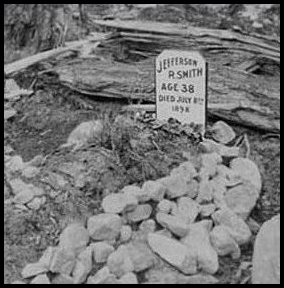
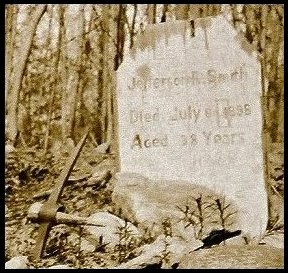
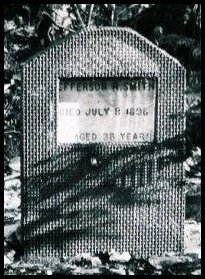
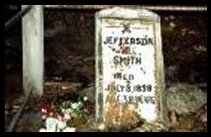
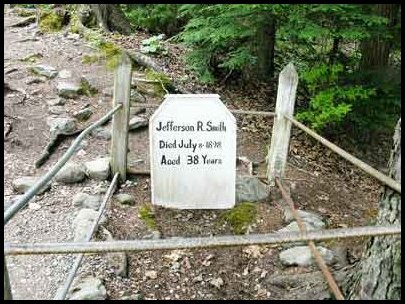
The Six Gravestones of Soapy Smith

Soapy Smith was a scoundrel, con artist, bunco man, and lowlife of the highest order, so he naturally left quite a lot of bad blood behind when he was shot to death in 1898, and this has taken a harsh toll on the sanctity of his final resting place. Friends of Bad Man Soapy Smith has written a history of Soapy’s six gravestones.

1898 – 1901. Stolen.

1901 (+-)- 1927. Washed out to sea in a flood.

1927 – 1950s. Became target practice for vandalism and gun practice.

Maybe same as above, but protected from target practice. Blown up with dynamite.

1950s -1997. Deterioriated naturally?

1997 – present