Category Archives: Uncategorized

the black giant of white spirituals

J. JacksonJesus Rose from The Colored Sacred Harp

This slim, oblong book contains as much community effort, as much eccentricity, and as much rich material as any of the shape‑note hymn compilations it is designed to resemble. It has a layered and recursive form, in which various streams separate and converge: a biography, a personal memoir of the folk revival, a critical survey of scholarly literature on African American Sacred Harp singing, a generous selection of evocative photographs spanning the twentieth century, and a CD that ranks among the most valuable and carefully compiled collections of historical Sacred Harp recordings ever assembled. John Bealle’s introduction plays the role of the traditional “rudiments of music” section of a shape‑note hymnal, providing a concise and sensitive history of Sacred Harp singing, its diverse adherents, and its intersections with the folk revival. Joe Dan Boyd’s prologue prepares the reader to engage the main body of the book (which dates from 1969) as a document of “the eager, innocent spirit by which so many people engaged traditional culture at that time” (p. 24). Boyd’s self‑awareness pervades the book and makes it a more complex work than most other celebratory folklore biographies.

In many respects, judge Jackson (1883‑1958) was much like other leading figures in the southern communities that sang from The Sacred Harp in the early twentieth century. He was born poor and rural, did agricultural work all his life, gained a patchwork music education from a variety of singing‑school teachers and friends, taught his own large family to sing, became a prosperous and charismatic cultural leader in his own community, and eventually compiled a shape-note tunebook that included some of his own compositions.

Here’s the shape note for singing along:
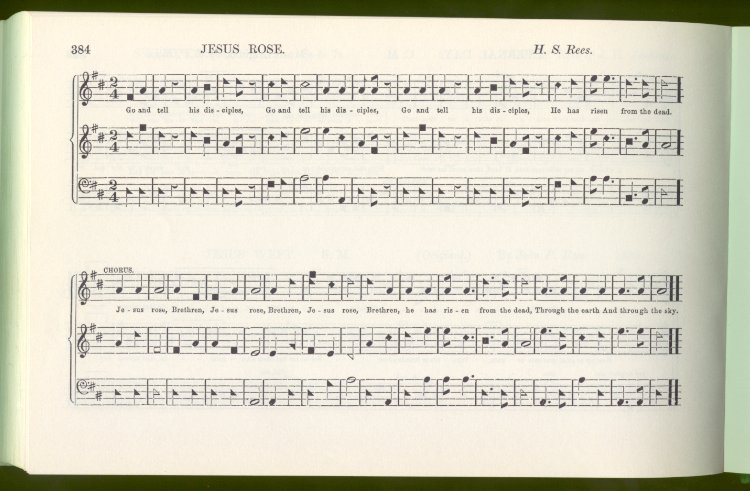
Jesus Rose

Relax Your Mind transcription

Update 3 days later: see Corrections for a version of the notation which ordinary mortals can read.

I put some time this morning into figuring out the guitar riffs on a
tune called “Relax Your Mind” by Leadbelly, aka Huddie Ledbetter. It
took some sweat so I figured I’d share the result for other people
to use.

Here’s an MP3 of the riff: MP3 of the riff.

This is how to play the part:

Relax Your Mind transcription

Notice that the part is in the very unusual key of C#. I think
Leadbelly tuned the guitar down a minor third, so that the E string
was C#, the A string was
F#, etc. Since I don’t tune like that I modified the lowest note in
the piece from low C# to C# an octave above that, on the 4th fret of
the A string. If you feel like tuning down, the note I changed is the first
one in bar 4.

The chords for the song are the same throughout: C#, C#7, F#, C#, C#, G#7,
C#. It’s an eight-bar pattern rather a 12-bar pattern like bar bands
usually do.

If you want to tweak the sheet music and have Sibelius (the
software I use for notation), here is the source Sibelius file: Sibelius
source file
.

If you use a digital instrument instead of the analog kind, here’s a MIDI
version of my transcription: MIDI
version of my transcription
.

A cool thing about this song is that it’s about road rage, even
though it was written way back in the 1930s. He’s saying that when
you’re getting pissed off about driving you need to take a deep
breath. Given that he was a full bore murderer, I think he knew about
road rage.

His musical ideas here are strongly influenced by ragtime and early
jazz. He leans on chromatic runs that are close cousins of boogie
woogie. The phrasing is so intricate that in one cadence he touches
almost every pitch in an octave without doing more than three
adjacent semitones.

I probably muffed a couple notes in my transcription, so please
share any corrections you come up with.

I found the original recording on MOG and on YouTube.

Horace Weston’s SF Jig

In this awesome gurdonark travelogue video using Horace Weston’s Old Time Jig for the soundtrack, I especially like the canned Windows Movie Maker transitions from cut to cut. Very 2010.

Today I finished my meetings in time to catch the BART back to SFO and my hotel. I was able to hike on the San Francisco Bay trail in Burlingame. The trail featured American redhead and mallard ducks, coots, seagulls, gray clouds, passing planes, cute dogs being walked, and ice plant flowers, bumblebees, waves on rocks, and distant foggy hills.

I took a lot of pictures. I also took a lot of video with a special camera–a little Chinese 4 megapixel camera I got on eBay for 25 dollars [a sunplus], whose light sensor gives an ethereal effect that Mr. Holga, whomever he may be, would envy.

I brought the video to my room at the Crowne Plaza, downloaded Windows Movie Maker 2.6 into Windows 7 ( which, does not come with the best MS program). I’ve long been a huge fan of your jig, and

made it the soundtrack to “Impressions: San Francisco”. It’s a kind of lo-fi sense of my afternoon:

homestyle mandolin sample pack

I have put together a sample pack of rootsy solo mandolin, a “matched set” to be used in different places in a long form podcast, radio show, or video. The set contains segments from a second or two up to about a minute, to be used for cues, hits, bumps, interstitials and voiceovers.

The chunks are in a variety of lengths – 2 seconds, 15 seconds, 30 seconds, and 45 seconds – to fit different functional requirements in a radio show or video. The longest segments are for a credit sequence or show opener. The 15 and 30 second segments are for voiceover ads. The 1-2 second bits are for marking the beginning or end of a story or scene.

I was thinking of the way the bass worked in Barney Miller. It was a key part of the theme song, and contributed little riffs at the beginning or end of a scene. Every one of these short bits here is a separate take with its own beginning, middle and end, not a clip from a larger work.

The instrument is my old Fairbanks mandolin. The feel is uptempo, excitable, peppy, perky, traditional, natural, organic, old time, americana. Time signature = 4/4, key = G blues .

This is an experiment, so I’d be grateful for feedback on what worked and what didn’t. How is the sound quality? Are there lengths of cue that you needed that weren’t here? I’m happy to do custom recordings to fill in the gaps. Just ask.

This work is licensed under a Creative Commons Sampling Plus 1.0 License. If you need a different license feel free to ask.

I have posted the whole set on Freesound and on Soundcloud, and for whenever the time comes that those go south, here they are on my own server:

00:18 (aiff): for a 15-second spot.

00:31 (aiff): for a 30-second spot.

00:31 (aiff): for a 30-second spot.

00:32 (aiff): for a 30-second spot.

00:45 (aiff): for a 45-second spot, for credits, or for a theme song.

00:37 (aiff): for a voiceover that isn’t precisely timed.

00:05 (aiff): quick hit for opening or closing a segment.

00:04 (aiff): quick hit for opening or closing a segment.

00:04 (aiff): quick hit for opening or closing a segment.

00:03 (aiff): quick hit for opening or closing a segment.

00:04 (aiff): quick hit for opening or closing a segment.

Homestyle mandolin cue set by lucas_gonze

aerialist

Aerial daredevils existed in the age of ballooning, as well as the age of powered flight. One assumes this woman was a circus performer who got swept up in the ballooning mania. The image itself has a surprisingly dreamlike quality, which is at odds with its inherent horror.