Category Archives: Uncategorized

playing MMM in Silverlake tonight

I’m playing tonight in Silverlake at the Where/ Meet Mix Mogul coworking space in Sunset Junction, at the intersection of Griffith Park and Sunset, next door to the Mornings/Nights coffee place.

1519 Griffith Park Boulevard 90026

Also on the bill will be Homesick Elephant:

And Siggy:

Homesick Elephant is a couple who do countryish harmony singing. Very upstanding. But not without knowledge of evil. They’re smart.

Siggy is a four piece band with a mopey raw rock sound. What I love about them is that they are very much a garage act, but they’re not kids. I’d guess the youngest person in the band is 40. It’s very bad ass to get up there and pull it off.

Doors open around 9 and close around 1.

“God Bless Our Land (Independence Day)” by Gurdonark

Gurdonark posted an ambient patriotic song for July 4th, with singing by SackJo22 and a guitar solo by me.

His mix is under a Creative Commons Sampling+ license. My own parts are Creative Commons Zero, aka public domain. Here are stems of my parts:
lead 1 (MP3),
lead 2 (MP3),
lead 1 (AIFF),
lead 2 (MP3).

Gurdonark’s liner notes:

This is a re-creation of a public domain 19th Century patriotic song.

Sometimes people speak of the commercialization of Christmas—the sense that its spiritual values get lost in a commercial blur.

I speak instead of the jingo-ization of the Fourth of July—the need to keep and universalize what really matters in the American independence day. I think that this holiday gets lost in sloganeering and military marches (and I say this despite being a J.P. Sousa fan).

I respect deeply those who sacrifice for our country. I learned last night that an old friend just retired from the Marines after receiving major shrapnel wounds in Iraq. My heart is with he and his wife and son, and I appreciate his courage.

We don’t forget those who sacrifice. The Fourth of July is not a celebration of a battle or a paean to American supposed “superiority”. It is a time to celebrate a declaration by people who wrote that people have inalienable rights which should be respected. We celebrate the values worthy of these immense sacrifices.

The Fourth of July is a holiday to celebrate what is wonderful about the American experiment. I believe these core values should be freedom, a respect for the rights and dignity of others, a just and righteous rule of law, and the ability to spread peace, liberty, and universal friendship.

John Sullivan Dwight lived from 1813 to 1893. Although he trained and served for a time as a Unitarian minister, he joined the transcendentalist movement and discovered his true vocation as a music teacher and writer.

“Dwight’s Journal of Music” became the most influential music publication of his era. Mr. Dwight receives credit for first introducing an appreciation for Beethoven’s work in this country. He served on the teaching faculty for the school at Brook Farm, the high-minded but ultimately failed utopian community

He wrote the lyrics to “God Bless Our Land”, which is about the country I wish to see born and reborn:

“God bless our land, may Heaven’s protecting hand, still guard our shore;

may peace her power extend, foe be transformed to friend, and all our rights depend, on war no more.

May just and righteous laws uphold the public cause and bless our name; Home of the brave and free, stronghold of liberty, we pray that still on thee, may rest no stain

And not this land alone, but be thy mercies known, from shore to shore, Lord make the nations see that men should brothers be, and form one family, the wide world o’er”.

My hope is that the Fourth of July becomes a celebration less of the might of nations, and more of the possibility for freedom and friendship for which men and women who sacrifice their energy and sometimes their lives.

I’d like to tell you about Helena Hill Weed. She graduated from Vassar College and the Montana School of Mines. She was a geologist by trade. She was “from the right family”: the daughter of a congressman and a member of the Daughters of the American Revolution. Yet as a woman she could not vote.

She had an Independence Day story. On July 4, 1917, she picketed in Washington, D.C. for women’s suffrage, carrying a sign that said “”Governments derive their just powers from the consent of the governed.”.

For her patriotism, she was arrested and served three days in jail. The source of her sign, of course, was the American Declaration of Independence. She and others like her continued their peaceful protests, and helped get the vote for women in her lifetime.

I’d like to tell you about Lou Gehrig, a great baseball player who contracted the fatal disease ALS, which is sometimes colloquially called “Lou Gehrig’s Disease”.

on July 4, 1939, he gave his farewell speech in front of his fans marked with courage and humility. But he was not just a go-along guy, saying what pleased the crowds. He also said “”There is no room in baseball for discrimination. It is our national pastime and a game for all.”

Finally, I’d like to tell you about July 4, 1997. This is when the Mars Pathfinder probe landed on Mars, beaming back pictures from an alien world far from Earth.

We can achieve equality and progress. These are our Independence Day ideals.

I believe in Independence Day as a day to celebrate the universal hope for freedom, friendship and equality, and as a day for the re-commit of efforts to help fulfill that hope for all.

The tune here is “The Italian Hymn” by Felice Giardini. Felice Giardini was born in Turin in 1716 and died in Moscow in 1796. He was a child prodigy as a musician and a prolific and capable composer. Music did not earn him the living he hoped, despite his great skills and imagination. Yet his songs live on, and serve as the basis for this new version of JS Dwight’s hymn for peace.

sort of Italian Song

This 35-second recording is a simple tune with two chords and one big phrase. I recorded it for a friend to use as a stem, and I’m posting it here because it might be useful to other people, maybe as a ringtone, as a cue in a video, or as a connector in a playlist.

This uses the chords from “Italian Hymn” by Felice de Giardini, so I’m calling it “sort of Italian Song”. I learned it from Mutopia.

sort of Italian Song (MP3)


CC0


To the extent possible under law, Lucas Gonze
has waived all copyright and related or neighboring rights to
sort of Italian Song.
This work is published from
United States.

photos from REDCAT

Dick and Jane playing music at REDCATDick and Jane playing at the lounge at REDCAT. Normally Jane curses like a sailor while she’s singing, but she kept it clean because of the kids there.


mini Sausage Grinder at REDCAT LoungeMini-Sausage Grinder playing jug band songs, early blues, a little bluegrass. These guys are good musicians without being showoffs, and for once I could hear all the fine details in their lines.

Notice these two photos are in totally different places in the bar. That was to enable one band to set up while the other was still playing, so that each band could start their first song right as the last song by the previous band stopped, like in a playlist.

thoughts on REDCAT show

The night of music at the downstairs lounge at Disney last night was an improbable success.

Factors against it — weird architecture; no walk-in traffic; venue that people aren’t used to going to; time slot right after work in a part of the city that few people work in.

So how come it worked ok anyway?

  • The people were a good mix who gelled socially. If it was a party folks would have been gabbing away.
  • The musicians (Dick & Jane, mini-Sausage Grinder, Triple Chicken Foot) were all excellent. As much as it’s a pleasure to be so close to players when they’re good, it’s painful when they’re bad and you can’t escape.
  • The acoustics were round, warm and clear. I could hear every detail of the sound, and the sound was beautiful. It was a great listening experience.
  • I tried to get musicians to start and end sets flush next to each other, with no break in between to fuss with the setup, like songs in a playlist. To do that I had two different playing areas, aka “stages”, so that one band would set up in one while the other was playing. In a couple spots this way of doing things was really magical, for example when Triple Chicken Foot’s first song started and the sound just opened up. (I don’t think this idea specifically made the good vibe, I think it helped establish a feeling of energy).
  • The quality of the artwork for the flier (by Angelina Elise) created a sense that this was a worthy event.

  • Because the space isn’t a bar and because it wasn’t late, there were kids around. They did a lot to make the atmosphere feel open and direct in way that a rock club never is.
  • The main room is on the small side, so it doesn’t take a lot of people to make it feel full.

Thanks to Aaron Drake at REDCAT for making it all happen.

In the future I’m going to try to incorporate kid musicians into the show, doing one song at a time. I think that will create a friendly and homey feeling towards all the musicians and the event as a whole. Not sure how I’ll find em, though. If you’re an LA parent with a kid who plays guitar, give me a ping.

old time night at Redcat Lounge thurs 6/18

Lucas Gonze in Americana night at REDCAT Lounge

Next Thursday 6/18 I’ll play at the downstairs bar at Disney Hall, called REDCAT Lounge. It’s an early bill from 6-9 to accommodate working people, the kind who don’t go out late during the week but would dig having a drink after work.

This is a night that I did the booking for. The other acts are fine local musicians who I play with pretty often —

* The inimitable Dick & Jane.

* The invincible Triple Chicken Foot

* A couple players from Sausage Grinder, which does jug band songs like Mississippi Sheiks in an authentic style with all the details.

Where? 631 West Second St., Los Angeles! But here’s a map:


View Larger Map

Triple Chicken Foot:
Triple Chicken Foot

quills => black winds

Instruments that originated among the black population had to be cheap. They used the body: patting juba, whistling, singing. Or they could be made out of materials in the woods, like making banjos from gourds and pipes out of split bark; both of these instruments came from Africa.

This kind of pipe was called “quills.”

I was thinking about black American wind playing influenced by quills, so I made a playlist:

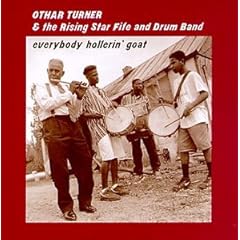
Otha Turner’s fife and drum style is mid- 19th century.
Henry Thomas’ blues quills are early 20th century.
Yusef Lateef’s jazz flute is late 20th century.

Otha Turner -> Everybody Hollerin’ Goat -> Shimmy She Wobble

Henry Thomas -> Texas Worried Blues -> Charmin’ Betsy

Yusef Lateef -> Eastern Sounds -> The Plum Blossom

party music

I jammed all evening in the garden at Dick & Jane’s party on Friday, and I had a great time.

We had good players, including mandolin, fiddle, and resonator guitar, and IMO we made a crunchy little beat happen. You could tell by the gushy reactions when we got up to leave.

So here’s my plea: hire us! We don’t need amplification, you don’t have to give us money, we’re not going to steal silverware, and we’ll make it a happening little party. It’s easy — just send me driving directions and I’ll do the rest.

from frontier badman to stardom in Hollywood

I asked Jeff Smith, proprietor of Soapy Smith .net and biographer of his great grandfather Soapy, whether there was a connection to LA. Jeff said that Soapy hadn’t been to LA, but Numerous friends and gang members were known to have lived or visited Los Angels:

Of interest might be Wilson Mizner, one of the old Skagway gang members, who in 1929, had become a partner in Hollywood’s Brown Derby restaurant.

School For Scoundrels says this about Mizner:

Wilson MiznerWilson Mizner

He worked as one of Soapy’s lieutenants until Soapy was killed. One of his scams included working as a gold weigher in a dance hall. While balancing the scales, Wilson would spill gold dust onto a carpet. At the end of the week Wilson burned the carpet then extracted the gold from the ashes. In a 1905 interview, Wilson claimed that this trick resulted in a weekly yield of a couple of thousand dollars.

In “Schemers, Scalawags and Scoundrels”, author Stuart B. McIver relates one quasi-comic episode in the Yukon: “In the gold rush days in Nome, Alaska, [Wilson Mizner] put on a black mask, armed himself with a revolver and entered a candy store, shouting, “Your chocolates or your life!” Though the local sheriff knew Wilson was the culprit, there was no arrest. Later he was named as a deputy sheriff!

In 1905, Wilson showed up at a horse show where his brother Addison was ensconced in a pricey box with wealthy widow Mary Adelaide Yerkes. Addison pretended not to see Wilson, but the younger brother charmed his way into the box. Thereafter, Wilson worked speedily. He spent the night with Mrs. Yerkes, reportedly borrowing $10,000 the next morning.

Mizner made his way from frontier Skagway, Alaska to boomtown Hollywood, where (according to Wikipedia) he became…

an American playwright, raconteur, and entrepreneur. His best-known plays are The Deep Purple, produced in 1910, and The Greyhound, produced in 1912. He was manager and co-owner of The Brown Derby restaurant in Los Angeles, California, and was affiliated with his brother, Addison Mizner, in a series of scams and picaresque misadventures that inspired Stephen Sondheim’s Road Show.

Back to Jeff Smith’s comments on Mizner:

He had known Wyatt and Josephine Earp in Alaska, probably Nome. When Earp died on January 13, 1929, in Los Angeles, Mizner was among Wyatt’s pallbearers. Two other Earp gang members were also in Soapy’s gang.

Wyatt EarpWyatt Earp at 21 in 1869.

According to Wikipedia Wyatt Earp was a famous *white* hat, the polar opposite of Soapy Smith, as well as a Gambler, Lawman, Saloon Keeper, Gold/Copper Miner:

He is best known for his participation in the Gunfight at the O.K. Corral, along with Doc Holliday, and two of his brothers, Virgil Earp and Morgan Earp. He is also noted for the Earp Vendetta.


Which all goes to show a weird thing that I have discovered via Soapy Smith: there was a direct connection between the old west and early Hollywood. There were people who held up stagecoaches who went on to work on movies. Nuts! No wonder there were so many westerns made.