I’ll be playing in a night of music at the Where/MMM coworking space in Silverlake. The idea is to cater to the small scene of people who hang out on the block on a regular basis, either at the coffee place next door, Mornings Nights, or at Where/MMM.
I put the event together. The idea is about the way that live music and real world communities have this symbiotic relationship. I noticed that people on the block know each other, and that there are plenty of musicians and creative people.
It’s a hyperlocal genre in that it’s about a specific place.
Particulars for the gig:
On Friday 9/11
Starting around 8 or 9.
No $ required, not exactly, but by no means would your contribution be refused.
There will be three main acts doing full sets. If you don’t know at least one of us on a first name basis, you probably aren’t the target audience. I have the impression that Jesse’s and Steve’s acts are good enough to have followings and bookings and all that kind of stuff. Jesse’s band is indie rock. It has a name, I just don’t know it. Steve’s thing is hip hop. He’s an MC. I will perform on the flying trapeze as always.
Every local is welcome to do a song or read their poem or do whatever they do. But only locals can perform.
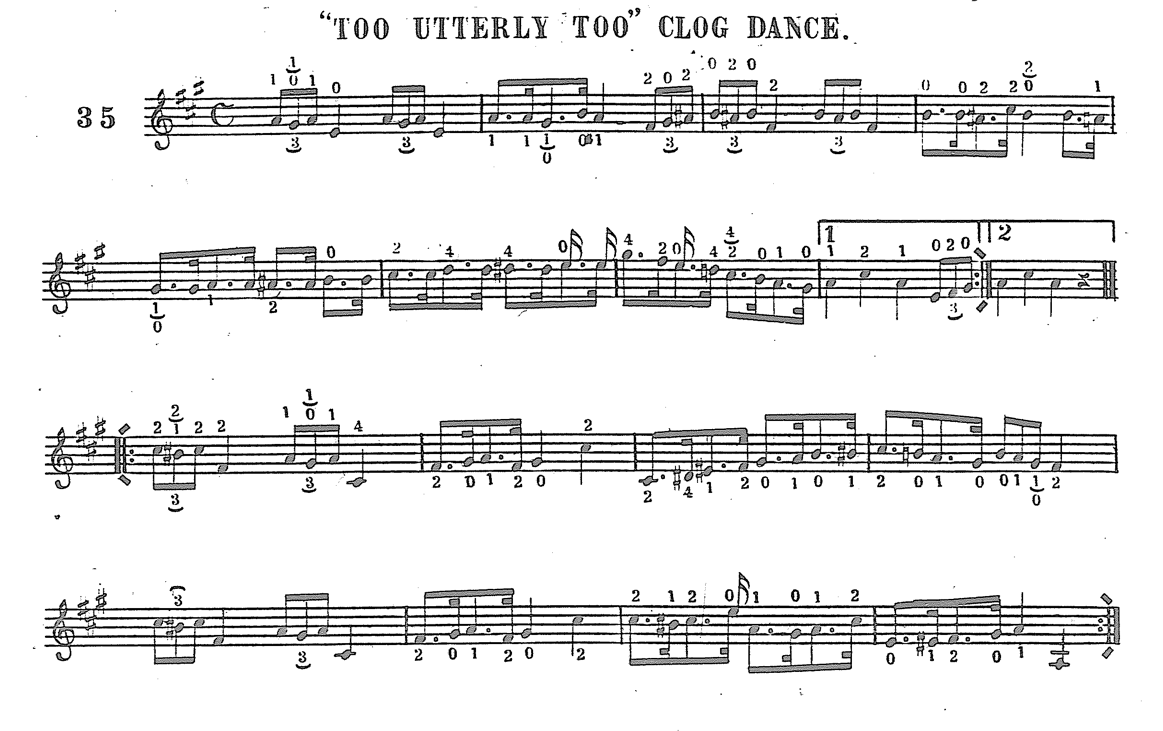
It’s from a book called “Banjoist’s Budget” by Mr. A. Baur. According to Carl Anderton:
Baur was from New York, soldiered in the Civil War, was badly wounded in Georgia during Sherman’s “March to the Sea,” and spent the next 9 years recovering his health. He practiced banjo constantly during his convalescance and became one of America’s leading players. His “Reminiscences of a Banjo Player” published in S.S. Stewart’s Banjo and Guitar Journal are quite insightful.
I didn’t find the date of this book, but I did find a stray comment on the internets claiming it’s from 1880, which sounds just right.
Here’s the sheet music for them that can read it:
My recordings here are all hereby dedicated to the public domain per CC0 1.0 Universal.
May 31, 1890: “New York City News,” “On Sunday last, there was buried from 194 Bleeker street, a man whose name once was the synonym for skill upon the banjo, Horace Weston. His career is a striking example of of the rise and fall of natural genius in the fickle field of fancy. Years ago he stood without a peer, and in clever measure, thumbed his melodies of the day before the crowned heads and rulers of the world. From troupe to troupe he drifted and through loose and careless habits gradually fell from grace, and saw the championship drift away from him.”
Fandango means “A lively Spanish dance in triple time performed with castanets or tambourines. The dance begins slowly and tenderly, the rhythm marked by the clack of castanets, snapping of fingers, and stomping of feet. The speed gradually increases to a whirl of exhilaration.”
The harmony dips into both blues and classical. I hear Paganini *and* Rev. Gary Davis. As an example of classical harmony, at the center of the piece is a dissonant chord in A minor spelled b-f#-g-d; notice the f# and g right next to each other, without even an octave between them to help them get along. As an example of blues harmony, he uses V minor (E minor) and V dominant (E7) interchangeably, without modulating, which makes the third a blue note.
Rhythmically it plays a subtle game with a strong offbeat and weak downbeat: 1 *2* 3 *4*. This was ten years ahead of ragtime and thirty ahead of jazz, and it’s clearly an antecedent.
A wonderful and special thing about Weston is that as a gifted and educated free black man in a time of poverty and intense ghettoization he was able to write his own story and document his times for himself. Very few black people were empowered to do that. And what do you find? The advanced rhythmic techniques that characterize all African-American genres _and_ mastery of European music theory.
In terms of my own playing here, I feel good about how it came out. I like the way the time ebbs and flows, and I like the brightness of the tone. There are no bad spots or mistakes. Also, I feel like I succeeded in bringing out the weird and awesome combo of blues and classical. But the recording is too short to really succeed. I feel like I needed to get at least two minutes out it to have something that people would listen to for its own sake.
The one good thing about the shortness is that this would be a natural soundtrack for a Flickr video, since Flickr videos can’t be longer than a minute and a half.
Anyhow, you’re welcome to remix my recording here, as well as download it, upload it, and tattoo it on your behind. It’s in the public domain.
To the extent possible under law, Lucas Gonze
has waived all copyright and related or neighboring rights to Egyptian Fandango.
This work is published from United States.
And while you are enjoying the music, here is something whacky.
W.G. Underwood, a sailor on board H.M.S. Calypso has adopted a new style of playing the banjo aloft while hanging by his teeth. He tells me (editor Emile Grimshaw) that the tune he was playing when this photograph was taken was “Lenton Waltz”. He also says that “although a simple tune, it always goes down well when played in this manner at a height of twenty feet.
I have kept using and improving my custom search engine for public domain sheet music for about a year now. It’s really useful, and all I have to do to maintain it is add new sites as I come across them. The reason this search engine is necessary is that sheet music vendors and malware sites have successfully gamed the search engines, so you can’t find free (as in freedom) sheet music unless you whitelist providers. If you know of new sites, let me know.
Around May 1917 Van Eps joined a touring group of recording artists, called at different times the Record Makers, the Phonograph Singers, the Eight Victor Record Makers, the Popular Talking Machine Artists, and the Peerless Record Makers. He replaced Vess L. Ossman, who allegedly had not gotten along with manager Henry Burr. Surviving programs show Ossman performing in April 1917, but in the May 1917 issue of Talking Machine World Ossman’s name is missing from a list of members. The group was called the Eight Famous Record Artists by June 1920, and after five members–Burr, Billy Murray, Albert Campbell, John Meyer, and Frank Croxton–signed exclusive Victor contracts in 1920, “Victor” was added to the name. Van
Incredible but true: after all those iterations the best band name they could come up with was Eight Famous Victor Record Artists. It’s like the answer to the question “How many Famous Victor Record Artists does it take take to screw in a lightbulb?”
Hard to imagine somebody putting that on the back of their leather jacket.
Horace Weston (1825-90), was one of the biggest stars of the minstrel stage during its heyday in the late 19th century, along with James Bland, Billy Kersands, and Sam Lucas. A freeborn black from Connecticut and a virtuoso banjo player, he started with Buckley’s Serenaders in 1863, but spent most of his career with the Georgia Minstrels. In 1873 he became the first black performer featured in a special role when he toured overseas in a production of Uncle Tom’s Cabin. Late in his career, he performed with the Ringling Brothers and Barnum and Bailey (Circus) Greatest Show on Earth.
One of Weston’s principal champions was Samuel Swain Stewart, a proponent of the banjo, who published pieces by Weston and other banjo players. Among Weston’s compositions are: “Horace Weston’s Home Sweet Home,” “Horace Weston’s New Schottische,” “Horace Weston’s Old-Time Jig,” “The Egyptian Fandango,” and “Weston’s Great Minor Jig.”
And over on the Library of Congress site for sheet music, here’s an 1883 composition by Weston that is an incredibly early publication for a black American composer, way way before its time:


 It’s a great little composition with a lot of spooky flavor. Very


