Author Archives: lucasgonze

“Must I, Then” -> “Muss I Denn”

In a comment on Must I, Then, Jim N posted that:

From a folksong book my grandfather gave me, I know that this is based on a German song, “Muss I Den”.

Here’s the german tune:

That’s definitely the same song. Good shot, Jim.

But what about the title? Google translate tells me that “Muss I denn” means “I have since” in English, not “Must I, then.” “Must I, then” must have become the title because it sounds the same. Maybe it was misheard by an English speaker who thought it was English.

And actually my favorite part of this song is the title. “Must I, Then” is a great name for a song.

byrondolin double neck

I ran across a 190? flyer for The Byron Troubadours : novelty musical entertainers that included a cool Led Zeppelin-esque instrument — a double-neck combo of a guitar and a mandolin — which was called the “byrondolin.”

The Byron Troubadours, who were also known as the Magnolia Quintette, doing a multi-jam:

byrondolin

Jimmy Page doing a mega-jam:

Jimmy Page with double-neck Gibson

So how about that byrondolin?

about the byrondolin

For more boss historical instruments, check out harpguitars.net.

Ella Waltz

MP3: Lucas Gonze with Gibson L3Lucas Gonze — Ella Waltz

This post is a recording of the composition Ella Waltz by D.E. Jannon, which was published in 1854.

It is the third of a set of three waltzes by D.E. Jannon. I have also blogged recordings of Amy Waltz and Carrie Waltz. I don’t consider the series finished because I want to redo the Amy one, but who knows whether I’ll really come up with a better version in the end. It takes a ton of practice and a lot of trial and error with the arrangement to make one of these recordings, and I have other tunes that I want to move on to.

As I was learning the 3 waltzes I made up a back story for them. In my imagination they are named after D.E. Jannon’s three daughters. They are ordered from oldest to youngest. Amy is a teenager, Ella is a little kid, Carrie is in-between. Amy is going through a phase where she is hustling all the time and in a hurry to get away from her parents. Ella has been falling down, dropping things, running into stuff, and generally being accident prone. Carrie is moderate in all things.

The original writing on this tune had dead spots, places where the writing was thin or weak and needed fixing, so I rewrote many of the parts. My version isn’t as simple as the original, which is a loss, but it sounds better.

By the way, I got the name of this tune slightly wrong while I was working, and even though I corrected it in the end some of the metadata and file names are wrong. Right: Ella. Wrong: Emma.

http://memory.loc.gov/cgi-bin/ampage?collId=mussm&fileName=sm2/sm1854/732000/732150/mussm732150.db&recNum=3&itemLink=D?mussm:2:./temp/~ammem_7r3O::&linkText=0

These recordings are released under the terms of the Creative Commons Attribution-ShareAlike 3.0 license per my boilerplate licensing statement.

This blog entry is a repost from my tech blog, where I was putting music before I created this blog.

Ogg Vorbis: Lucas Gonze — Ella Waltz

spirit rappings

Lucas Gonze – Spirit Rappings (mp3)

Spirit Rappings (title page)

August 20, 1852, Wednesday

Page 2 of the New York Times

Mr. ORVILLE HATCH, of Franklin, Conn., has become insane, he having devoted considerable attention to the subject of Spirit Rappings. Mr. HATCH is a farmer, and has been instrumental in introducing many important improvements in agriculture into the town in which he resides.

Madame Pamita, whose performances involve both spiritualism and really old American music, sent me a pointer to sheet music for an 1854 tune called “Spirit Rappings”, presumably because it’s a great number for Halloween. This post is my version of it.

Since I did a vocal part for once, the mix has the guitar and vocal parts hard panned to left and right so you can pull out the singing and do karaoke.

This recording is under a Creative Commons ShareAlike-Attribution 2.0 license. See also my boilerplate copyright statement.

Ogg Vorbis version: Lucas Gonze – Spirit Rappings (vorbis)

This blog entry is a repost from my tech blog, where I was putting music before I created this blog.

brogans

I needed a pair of shoes aside from sneakers or work boots for the musical act, which is old-time to an extreme, so I went out looking for 19th century clothes on the net. After digging around for a while I ended up in the civil war reenanctment scene, which is oriented towards people dressing up in oldy clothes like Confederate army outfits.

I decided that I liked a style called a brogan, which is antique looking but not pansy, and after surfing a bunch of sites ended up buying a pair of brogans from a site called Fall Creek Sutler. The site seemed a bit dicey, just not very organized or slick, and designed in the style of the early web, so I was a little leery about sending them money. All the sites in this vein are like that, though — small operations with roots in the old mail-order business, no credit cards accepted — and the shoes were priced decently at $100, so I printed out the order form and mailed it in with a check.

The order took a while to arrive, but this was in line with the site’s promise of 4-6 weeks to delivery. And all the other stuff I ordered was there and in good shape.

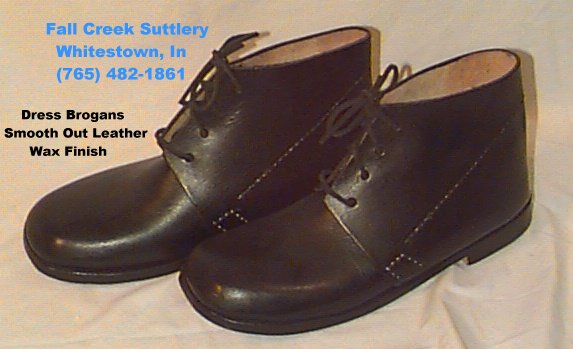
Out of the box the shoes were way cool. Brutally simple, no ornamentation at all. Straight up leather with nothing synthetic in any way. Soles stuck on with small wooden pegs. Ultra soft on your feet. Big and roomy. The best thing is that they don’t have the reverse left/right symmetry of modern shoes. They’re perfectly straight instead, so that they look almost like I have my shoes on backwards.

Here’s what they look like:
brogans

One thing I didn’t like about them was that I ordered them with metal heel plates to make the leather soles last longer and the heel plates turned out to be insanely loud. I walked the dog in my quiet residential neighborhood and the clicking sound really bugged me.

So I took them to a shoe repair place in my neighborhood. The place I went to is called Maya Shoe Repair. It’s a tiny storefront with an award on the wall from a shoe repair convention in 1972. I asked the guy to take off the heel plates and put on rubber soles. $38. Coulda been worse. Buying another pair would have been more expensive, and ordering the heel plates was my own fault.

When I picked them up the shoe guy was blown away. The style is obviously very unique. The shoes are crazy wide — officially EEE and in practice more like EEEEE. And he was in awe of the workmanship. Completely handmade. Good quality leather. Solid stitching.

Even though I had to get some insoles to make them fit, the store threw them in for free, and the guy cut them to fit. Nice guy.

Anyhow, the whole experience was a little over the top as far as buying a new pair of shoes goes, I could have spent 20 minutes in any mall and still gotten something decent, but these are badass and feel great. Plus they’ll give the stage act a bit more style.

Celebrated Shoo Fly Galop

This post is a recording of Celebrated Shoo Fly Galop by W.L. Hayden, which was published in 1877.

I like the way this rocks out. It’s a fun uptempo dance tune. Also I dig the idea of the celebrated shoo fly, which reminds me of a Mark Twain story called “The Celebrated Jumping Frog of Calaveras County:”

In compliance with the request of a friend of mine, who wrote me from the East, I called on good-natured, garrulous old Simon Wheeler, and inquired after my friend’s friend, Leonidas W. Smiley, as requested to do, and I hereunto append the result. I have a lurking suspicion that Leonidas W. Smiley is a myth; that my friend never knew such a personage; and that he only conjectured that, if I asked old Wheeler about him, it would remind him of his infamous Jim Smiley, and he would go to work and bore me nearly to death with some infernal reminiscence of him as long and tedious as it should be useless to me. If that was the design, it certainly succeeded.

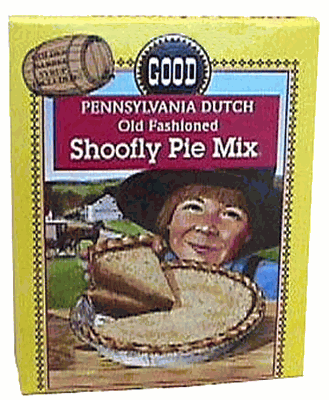
So what kind fly is a shoo fly, anyway? There is no such thing. It’s a folksy expression along the same lines as like flies to shit or keg flies. For example, the shoo flies in this 1915 recipe for shoo fly pie don’t mean the pie is made of bugs, they mean it’s sticky and sweet:

shoo fly pie recipe

How does shoo fly pie taste? According to this person who made it, your mileage may vary:

To me this pie did not smell good or look good but Darrell’s co-workers seemed to like it.

holding a shoo fly pie


The dance is something called a galop. I come across a lot of galop music and references to the galop, so it must have been popular. The Polka History of Dance explains it this way:

The popularity of the polka led to the introduction of several other dances from central Europe. The simplest was the galop or galoppade which was introduced into England and France in 1829. Dance position was the same as for the waltz or polka, with couples doing a series of fast chassés about the room with occasional turns. Music was in 2/4 time, often merely a fast polka. The galop was particularly popular as the final dance of the evening.

And wikipedia says:

In dance, the galop, named for the fastest running gait of a horse (see gallop), a shortened version of the original term galoppade, is a lively country dance, introduced in the late 1820s to Parisian society by the duchesse de Berry and popular in Vienna, Berlin and London. In the same closed position familiar in the waltz, the step combined a glissade with a chassé on alternate feet, ordinarily in a fast 2/4 time. The galop was a forerunner of the polka, which was introduced in Prague ballrooms in the 1830s and made fashionable in Paris when Raab, a dancing teacher of Prague, danced the polka at the Odéon Theatre, 1840.

The galop was particularly popular as the final dance of the evening. The “Post horn Galop” written by the cornet virtuoso Herman Koenig was first performed in London, 1844; it remains a signal that the dancing at a hunt ball or wedding reception is ended.

There are mistakes left in the recording. Unedited solo acoustic instrumentals on guitar are an unforgiving form, and I’m not yet good enough to get a perfect take within a reasonable amount of time and labor. The medium is like watercolor painting in the sense that no corrections are possible. The hardest part for me is the tradeoff between passion and correctness. I can do a version with no ugly mistakes pretty reliably, and I can do something which is passionate and musical any time I’m in the right mood, but I can’t consistently do both at the same time. At the same time, the sonic clarity of 1-track real-time acoustic playing means that I can’t avoid a hard phrase by mumbling it or cover it up by emphasizing whatever is on other tracks.

I learned this song from David Allen Coester‘s digitization of “Hayden’s Star Collection of Guitar Music.” There is no composer in the original publication, and Hayden is credited as the arranger rather than the composer, but I gave Hayden the composition credit by default. Here is the sheet music:

http://www.meantone.com/MusicDownloads/StarCollection/StarCollection.html

These recordings are released under the terms of the Creative Commons Attribution-ShareAlike 3.0 license per my boilerplate licensing statement.

Must I, Then

This post is a recording of the composition Must I, Then? by W.L. Hayden, which was published in 1877.

The title of this song is my favorite part of it. There are about 100 silly questions you could make up for the request this person is responding to. “Ebenezer, please walk the cow to the auto show.” Etc. Fill in your own.

This song is a bit too pretty for me to be comfortable with, but then again that’s the 19th century for you. It’s just the esthetic of the time. Irony was far in the future, as relevant to them as 22nd century art is to us.

The source is an 1877 book entitled “Hayden’s Star Collection of Guitar Music.” The book was kindly digitized and hosted by a guy named David Allen Coester. Coester is an independent musician who just happens to be bringing primary historical materials on the internet.

There is no composer listed, and Hayden is credited as the arranger, not the composer. I gave him the composition credit by default.

I like the lines in this composition. The phrases aren’t broken up neatly, instead they stretch out into long run-on sentences. The result is that the song is really just two lines.

It’s surprisingly hard to play. This tiny bit of music took me a long time to master, and even now I make a lot of mistakes. There is an easy way to play it but it sounds cramped. To let the notes breathe I picked fingerings which use open strings rather than fretted ones whenever possible. This enables them to ring for longer and gives them a woody resonance. Using open strings rather than fretted ones is tricky when you’re up above the first position, because it effectively means that you’re playing in two positions at the same time. Another difficulty is that the note after an open note can’t be on an adjacent string, because then my finger on the adjacent string will accidentally lean over and stop the ringing note. The requirements aren’t hard to meet on a physical level, but there are mental gymnastics that I can only pull off when I’m in a state of deep concentration.

I have heard this style of fingering called “harp picking” because the overlap of ringing open strings gives a shimmering quality similar to a harp. I don’t really lay on the shimmering sound, though. It sounds like you’re trying too hard when you hit people over the head with it.

http://www.meantone.com/MusicDownloads/StarCollection/StarCollection.html

These recordings are released under the terms of the Creative Commons Attribution-ShareAlike 3.0 license per my boilerplate licensing statement.

hoop skirts

Cora Hatch

From a paper on the poem “Nothing to Wear”:

Cora Hatch’s public appearance had elements of both Harper’s New Monthly “true woman” and Flora M’Flimsey. In her initial divorce petition, she complained that B. F. Hatch refused to buy her flannel petticoats even though he freely paid large sums for her gowns and, especially, frilly and fashionable undergarments. The point of such garments was to be seen wearing them. The view that hoop skirts were designed to hide a woman’s legs is exactly wrong. They were to show them off.

woman in hoop skirt on a low table indoors with another woman looking on.
woman in hoop skirt in public, with a bit of leg showing and a man looking.

In the first cartoon, Clara is consulting with her friend Julia. She has rigged up an “imitation set of front door steps. “What is the effect now, Julia dear?” Julia replies: “Charming, love, you might even flirt just a little more with safety.” In the second, a voyeur is shocked to discover that the young woman’s calf is padded. It is titled “The Padded Calf — Veal A La Mode.” The cartoon warns the young woman (rather than chastises the man): “Don’t stuff your calves with bran, lest you should re-veal the real state of your understanding.” The “Patent Padded Calf” was a real product. Women did pad their calves, if they were insufficiently plump, because their dresses rose in the back whenever they bent over or ascended stairs and in the front whenever they sat down.